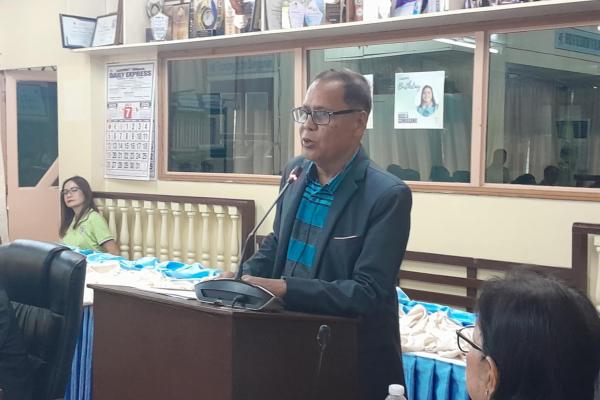

House Committee on Higher and Technical Education Chairperson and TINGOG Party-list Rep. Jude Acidre on Wednesday welcomed the House of Representatives’ ratification of the bicameral conference committee report on the proposed Presidential Merit Scholarship Programs Act, saying the measure would strengthen support for outstanding Filipino students pursuing priority college and technical-vocational programs, while helping meet the country’s workforce and development needs.
The House ratified the bicameral conference committee report on October 6, reconciling House Bill No. 8477 and Senate Bill No. 2410. Among the principal authors of the House measure are TINGOG Party-list Reps. Yedda Marie Romualdez, Andrew Julian Romualdez, and Jude Acidre.
Acidre, who also served as Chairperson of the House panel in the bicameral conference committee, said the measure brings Congress closer to ensuring that academic excellence is matched by the support students need to complete their education.
“This brings us closer to giving outstanding Filipino students the support they need to complete their education and use their talents in service of our country,” Acidre said.
A priority measure of the Legislative-Executive Development Advisory Council (LEDAC), the proposed law establishes two scholarship programs: the Presidential Merit College Scholarship Program under the Commission on Higher Education (CHED) and the Presidential Merit Technical Scholarship Program under the Technical Education and Skills Development Authority (TESDA). The existing Bagong Pilipinas Merit Scholarship Program would be integrated and subsumed under the two programs.
The programs provide separate pathways for students pursuing priority college degrees and technical-vocational diploma programs. Covered disciplines and sectors include science and technology, artificial intelligence, advanced manufacturing, agriculture, health and allied health sciences, specialized teacher education, and other fields critical to national development and workforce needs.
“By supporting both academic and technical excellence, we recognize the different ways Filipino talent can contribute to national progress,” Acidre said.
For the college scholarship, applicants must rank within the top one percent of Grade 11 students in their respective senior high schools and obtain a general weighted average of at least 95 percent or its equivalent, alongside the other eligibility requirements. For the technical scholarship, applicants must have a general weighted average of at least 90 percent or its equivalent, with priority given to those completing the senior high school Technical-Professional Track.
The measure also sets a family income ceiling of ₱2 million, subject to periodic review and adjustment. To broaden access, college scholarship slots would be equitably distributed among regions, while applicants from underrepresented areas and socioeconomically disadvantaged households would be given preference when candidates are equally qualified on academic merit.
For qualified scholars, support would go beyond tuition. Subject to available funding and implementing guidelines, assistance may cover school fees, living expenses, relocation, room and board, transportation, books, connectivity, laboratory expenses, and costs related to internships, licensure or board examinations, thesis preparation, and research.
“For a deserving student, this can mean being able to pursue a demanding course without the constant fear that family finances will force them to stop. For the country, it means developing the professionals and skilled workers we urgently need,” Acidre said.
Scholars would also receive a Certificate of Presidential Recognition signed by the President, which may be conferred during senior high school graduation whenever practicable. The proposed measure likewise requires clear timelines for the processing and disbursement of scholarship benefits.
The measure also protects existing Bagong Pilipinas Merit Scholarship Program scholars during the transition and provides safeguards against reducing benefits while a scholar remains qualified and eligible.
Beyond helping scholars complete their education, the proposed law links scholarship support with service to the country through its “Galing Para sa Bayan” component.
Under the measure, scholars would render service in the Philippines for a period equivalent to the years of scholarship assistance they received. This may take the form of employment, professional practice, research, teaching, community engagement, or public service aligned with their fields.
Acidre thanked his fellow House conferees, Representatives Roman Romulo, Ryan Recto, and JC Abalos, and their Senate counte